

Researchers at the University of California San Diego have developed a new digital platform that helps governments anticipate infectious disease outbreaks and prepare resources in advance. Built in collaboration with UNICEF and New Light Technologies, the tool is currently being deployed in Peru and Brazil to support planning around dengue and malaria.
The platform, called the Disease Incidence and Resource Estimator (DIRE), was designed at the UC San Diego School of Global Policy and Strategyto bridge the gap between academic disease forecasting and real-world decision-making. DIRE combines geospatial predictive analytics with interactive mapping to show where outbreaks are likely to occur, and what resources may be required to control and treat them.
“This project is about getting academic breakthroughs off the shelf and into the hands of the people making decisions,” said Gordon McCord, associate teaching professor at UC San Diego and principal investigator of the project. “We took machine-learning models that predict dengue and turned them into something governments can actually use, so they can plan ahead and act before cases spike.”
From prediction to preparation
DIRE focuses on Brazil and Peru and allows users to explore disease risk at multiple geographic levels. For each location, the dashboard displays historical case data, short-term projections for the current and following two months, and a range of environmental and socioeconomic indicators used in the model. Areas with higher uncertainty are clearly flagged, helping decision-makers balance risk with confidence in the forecasts.
Beyond predicting case numbers, the platform estimates the personnel, commodities and associated costs needed for disease control and treatment in each jurisdiction. This includes inputs such as vaccines, fumigation kits and staffing requirements, effectively translating epidemiological forecasts into operational planning data.
“It not only tells you how many cases of the disease are coming,” McCord said. “There’s a model underneath it that’s telling you how many resources would be needed in that place next month, how many doses of vaccine and what those costs would be, how many fumigation kits… It’s trying to do as much of the government’s job for it.” The platform can also generate downloadable PDF reports intended for local leaders, providing a concise, location-specific overview of risk and preparedness.
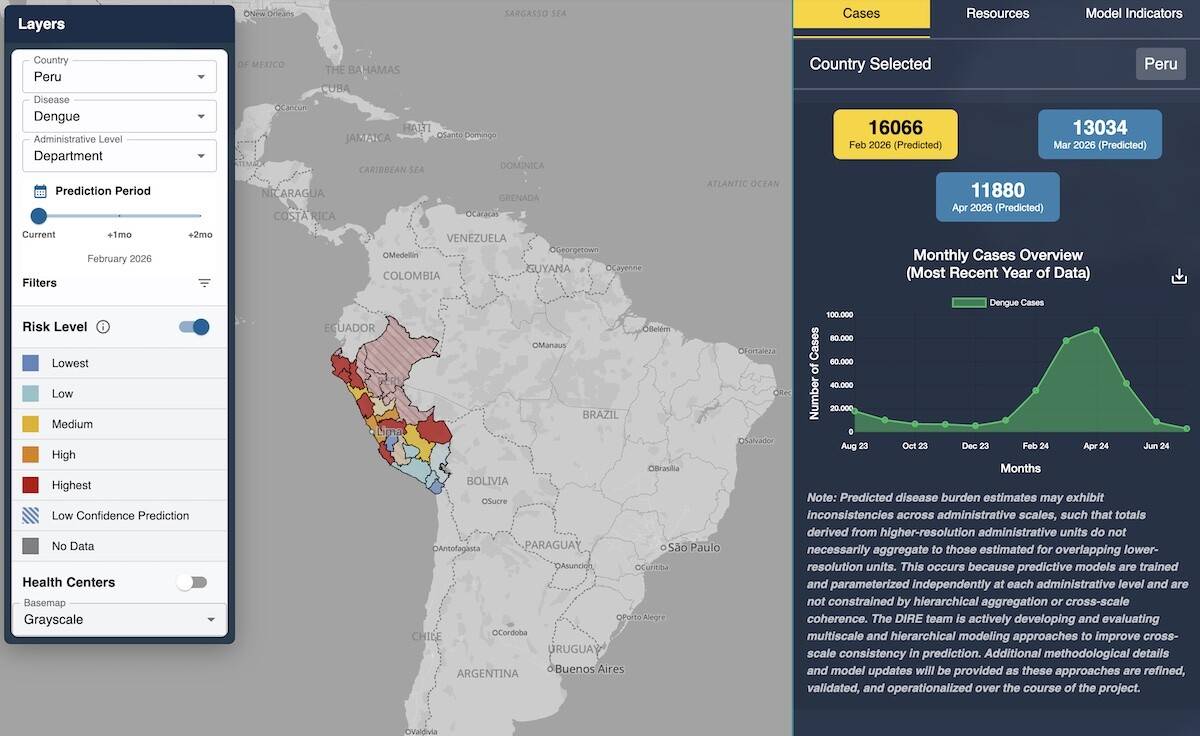
Persistent and growing threats
Dengue and malaria remain significant public health challenges in Latin America. According to McCord, changing environmental conditions, such as climate change, deforestation and land use change, are increasing exposure to mosquito-borne diseases, particularly in and around the Amazon region. Population movement into previously uninhabited areas further compounds the risk.
Malaria continues to pose a persistent threat in parts of Peru and Brazil, where ecological changes and weather-related factors such as heavy rainfall and flooding can expand mosquito breeding sites and complicate control efforts.
Carlos Orlando Zegarra Zamalloa, Health Specialist at the UNICEF Peru Office, highlighted the urgency of the problem. “Climate-related outbreaks like dengue and malaria are becoming more frequent and dangerous in Peru, especially for children and pregnant women. In 2025 alone, Peru reported 39,000 dengue cases, with a substantial proportion affected being children; the scale has been overwhelming the current capacity of governments and communities to respond effectively.”
DIRE development
DIRE was developed together with a broad group of stakeholders. Gabriel Carrasco-Escobar, now affiliated with Universidad Peruana Cayetano Heredia in Lima, supported the project, alongside input from organizations including the National Oceanic and Atmospheric Administration, the Government of Peru, the Institute for Health Modeling and Climate Solutions in India and UNICEF regional offices.
From the outset, user feedback shaped the design. “We brought together stakeholders and asked what would be a useful product,” McCord said. “We showed lots of iterations to Peruvian CDC officials, Brazil’s dengue program and UNICEF teams in Peru and beyond.”
Prevention and earlier response
The predictive engine behind DIRE is based on an ensemble machine-learning approach described in a 2024 study published in Scientific Reports, originally developed through work by UNICEF and the European Space Agency. UC San Diego researchers translated this science into a platform designed for real-time decision support and extended the framework to malaria.
Currently in a soft-launch phase, DIRE is being refined in terms of interface and data quality. The longer-term ambition is to expand the platform to additional countries and health threats. “Ultimately, success looks like governments being able to act earlier,” McCord said. “If you can see what’s likely coming, and what resources you’ll need, you can move from reacting to outbreaks to preparing for them.”
Predicting dengue outbreaks
Last year researchers at Northeastern University developed a machine learning model capable of predicting dengue outbreaks with around 80 per cent accuracy, offering new possibilities for preventive healthcare in high-risk regions. Using ensemble methods, the approach combines multiple predictive models and selects those that perform best over a three-month period for each location. This enables more targeted and timely forecasting, even when data are incomplete. The models were tested at 180 sites worldwide, including regions with limited testing capacity, where accuracy remained high.
Analysis of data from 14 countries in the Americas also revealed that dengue outbreaks often spread in waves from south to north, influenced by climate, human mobility and local infrastructure. According to the researchers, such insights can help policymakers anticipate outbreaks and better prepare public health responses.

Add ICT&health on Google
Show more content from ICT&health in Google Search.


