

China has transitioned from a recipient of Western medical innovation to a major exporter of novel drugs, leading health AI and advanced medical technologies. In her new book China Cure, Dr Ruby Wang examines how this transformation happened and what the country’s growing health and biotech power means for healthcare around the world.
Which state-led projects are currently driving China's push to become an AI and biotech health superpower?
China has long-term, broader strategies to guide progress, plus more specific policies to direct implementation.
The 15th Five-Year Plan emphasizes universal health coverage, health system strengthening, and support for an aging population. And in terms of biotech and life sciences, this means defining the sector as a high-quality productive force, supporting national major science and technology projects in biomedicine, research into drugs, vaccines, medical equipment, and brain-computer interfaces, greater sharing of health data, national AI application pilot bases, and AI in diagnosis, precision medicine, and health management.
For health specifically, there is Healthy China 2030. Initiated in 2016, it is a staggering 15-year blueprint for the healthcare sector as a whole, including system strengthening and sector progress. For biotech and innovation specifically, long-term industrial policy strategies have also enabled research funding, science parks, talent programs, and support for pharmaceutical manufacturing.
For AI, there is a broad “AI+” strategy as well as Internet plus action plans.
At the intersection, a specific “AI + Healthcare” implementation plan in late 2025 set out national AI testing and application bases, high-quality medical datasets, trusted data spaces, specialist medical models, and much wider use of AI in primary care and hospitals.
Beyond policy and governance, China’s intense market competition and regulatory reform have also contributed to progress, speed, and scale. That can create waste and imitation, but it can also drive rapid iteration and intense pressure to improve.
China is pushing its open-source models like the latest Kimi K3. Are they already being deployed in Chinese hospitals, and if so, how?
There has been evidence of Chinese hospitals and health providers piloting and deploying open models, particularly DeepSeek. I haven't personally seen convincing evidence yet that Kimi K3 specifically has been deployed at meaningful scale in hospitals – this was only recently released. But I am sure there will inevitably be more evidence, data, and implementation in the near future. China is quick to experiment and deploy AI in its health system. e.g., DeepSeek was deployed very quickly. In 2025, hospitals began using it within 2 months of its release, across almost every province – mostly in tertiary hospitals.
It’s important to note that AI applications in healthcare operate across multiple layers, not only the headline-grabbing front end, such as AI doctors (see Ant Afu), but also the backend, logistics, and the “drier,” less visible applications that are often more essential and more likely to improve efficiency: information retrieval, data summarization, EMR efficiency, quality control, and patient flow.
Open-model architecture does not necessarily lower the barrier for hospitals to use the technology because they often lack the capacity or skill set to work with it. They are clinicians and healthcare experts, not technical specialists, and deep technical expertise is essential for patient safety.
They still need technical support to innovate and digitize, but open models can encourage more actors to experiment, innovate, and indirectly support the health system.
What are the most significant recent breakthroughs coming out of China's biotech sector?
There are almost too many developments to list, and more are springing up daily. The trends of change and progress in the system are more important than any one drug. China is now undeniably producing globally competitive, quality, cost-effective drug assets with the potential to be best-in-class or first-in-class worldwide.
The outlicensing figures showcase this as a fact. Global science conferences show a growing share of clinical trials involving Chinese drugs; global MNCs and biopharma are buying from China because much of the world’s best potential medicines are now there.
A classic example is ivonescimab, developed by Akeso for lung cancer. In 2024, a phase III trial shocked the world. The drug doubled median progression-free survival compared with the existing category leader, pembrolizumab/Keytruda by Merck. This was one of the defining cancer medicines of the past decade. Many say this was one of the first real examples of the beginning of recognition of China’s biotech wave.
Since then, more and more examples have emerged. In 2021, China’s outlicensing deals over 50million USD were 3- 4%; by 2025, it was 30%; and in 2026 so far, only in Q1&2/H1, it’s already around 30% – more than 90% of the entirety of 2025.
China now has a sophisticated and increasingly deep biotech ecosystem, with pipelines strong enough that global pharmaceutical companies are systematically looking to China for innovation. The country is also building strength in newer and more sophisticated modalities, including ADCs, bispecific and multispecific antibodies, and cell therapies, with AI increasingly supporting drug discovery through target identification and molecular design.
Could China realistically become the world's leading health superpower? What would that mean for patients and health systems outside China?
China has already become one of the world's most important centers of drug development, and its pharma pipeline is second only to the United States. It is also a major medical-device and hardware manufacturer. Companies like Mindray already dominate hospitals across the US, Europe, Africa, and LATAM with high–quality, cost-effective machines and robotics. It has enormous capabilities in AI and industrial capacity and manufacturing, which also superboost its health sector progress.
This means that health sector decisions made in China increasingly influence what drugs are available globally, how much health technologies cost, where they are manufactured, and what kinds of health infrastructure other countries build.
For patients outside China, that could be profoundly positive. More competition can mean more drugs, faster development, potentially lower prices, and more cures for vulnerable patients worldwide. And because, thus far, many of China’s drugs are being outlicensed to foreign MNCs, a cancer patient in London or New York may increasingly receive a medicine first discovered in Shanghai or Suzhou, without thinking of it as a “Chinese medicine” at all, because it will be branded as an American drug, with much of the revenue received by that American company as well. In medical devices and hardware, China may be better able to export machines and robotics directly in the next few years.
What China is doing in digital health at home is also important. Health apps like Ant Afu, JD Health, and PA Good Doctor report hundreds of millions of users per month. That scale and data then enable the system to grow, iterate, and improve much faster. While not necessarily as exportable or able to cross borders as drugs or hardware, China’s sophisticated digital health ecosystem is showing the world – the front end of where tech can be enabled in healthcare – whether that is doctor avatars, BCI, or other. It also highlights the vulnerabilities and extremes of dependence, data governance, standards, and geopolitics. These are essential lessons for other health systems, which may be progressing more slowly due to regulatory, cultural, or other factors back home.
How are Chinese patients already using AI to manage their own health day to day?
Every part of life in China is digital, and AI is seen to be much more normal, or even expected there, than in many countries. The search bar of most apps now integrates AI. And this includes health apps too. Some of it is mundane and efficiency-driven: booking appointments, paying medical bills, ordering medicines, retrieving results. Others are more distinctive, like the AI doctors I mentioned earlier. There is huge uptake and adoption and openness and eagerness from the consumer/patient point of view – convenience, efficiency, and a very different attitude towards privacy than much of the West, contribute towards large-scale adoption.
China’s 2025 AI-health plan explicitly calls for intelligent chronic-disease management, personal health profiles, dietary and exercise advice, AI-supported maternal and child health, intelligent appointment systems, pre-consultation and follow-up services.
Chinese patients are already accustomed to healthcare being mediated through digital platforms. AI becomes another layer within services they already use. In a country where people pay at their grocery store using facial ID and can get something delivered within 20 minutes, it’s almost expected that health will be digitized rather than require a dramatic leap from analog medicine.
This does not mean regulations are more lax than in other countries. Policies, regulations, and laws are many and specific, with designated stakeholders responsible for implementation. But of course, the risks are often similar to those in other countries, with digital literacy affecting health inequalities, questions over responsibility for medical errors, and uncertainty over the distinction between consumer health tools and medical care.
What's the long-term vision driving Beijing's approach to health tech?
Urgency is promoting innovation as a need. China's rapidly aging population and its health system across a continent-sized country with major geographic and workforce inequalities. Technology could help scarce expertise reach remote regions, improve efficiency, and address the shortage of doctors and other health professionals.
There is also the economic objective: biomedicine, AI, medical devices, brain-computer interfaces, and robotics are industries in which China wants globally competitive companies and intellectual property. Then there is resilience and power. China spent decades depending heavily on imported high-end medicines and technology; greater domestic capability gives it more control over its own health security and supply chains – this is part of why biotech is recognized as a key pillar and a high-quality productive force within national plans.
Healthy China 2030 sets a goal of life expectancy reaching 80 by 2030, and part of this will be relevant to how the country is promoting biomedical science, AI, data infrastructure, and advanced medical equipment. The long-term vision is therefore to improve upon a health system where technology helps China manage aging, chronic disease, and inequalities in access. Meanwhile, the industries producing those technologies are becoming an important source of national economic and strategic power.
Is Chinese society genuinely receptive to AI in medicine, or is adoption being driven from the top down?
Both forces are operating. China has very strong top-down support for medical AI. Central government documents explicitly set adoption targets, local governments run pilots, and public hospitals can move quickly once policy direction becomes clear.
At the same time, strong bottom-up demand for digital convenience exists. Chinese consumers adopted mobile payment, super-apps, e-commerce, food delivery, and digital financial services earlier and more comprehensively than consumers in many Western markets. Healthcare platforms then developed within that environment. As we said earlier, many patients already expect to book, pay, retrieve results, and obtain services through their smartphone. An AI assistant embedded inside that process can feel like an incremental improvement, rather than an entirely new relationship with medicine.
There is also enormous commercial pressure. Chinese internet and healthcare companies compete aggressively for users. Hospitals compete for reputation and efficiency. Once something like DeepSeek appears, hundreds of institutions can begin experimenting with it almost simultaneously. So it’s about the interaction and reinforcement between government direction, commercial competition, and consumer behavior.
How would you describe China's biotech ecosystem today? Who are the key players, and how does it compare to Silicon Valley or Boston?
Increasingly sophisticated, mature, and confident. Established innovative companies now include BeOne, formerly BeiGene – now a global MNC based in Switzerland rather than a Chinese company –, Hengrui, Innovent, Akeso, Legend Biotech, and CSPC. Around them is a much larger generation of specialist companies working in ADCs, antibodies, cell therapy, RNA, small molecules, and, increasingly, AI-assisted drug discovery.
The ecosystem is also supported by an enabling layer of WuXi and other CRO and CDMO companies, large numbers of hospitals running clinical trials, universities and research institutes, increasingly sophisticated investors, and a substantial pool of scientists and executives with experience in American and European pharma.
Geographically, there isn't a Chinese version of a single site like Boston or SV. Shanghai's Zhangjiang industrial park is perhaps the clearest dense – and huge – biotech cluster with industrial density. Companies can move between medicinal chemistry, preclinical work, manufacturing, and clinical development through a very extensive domestic supply chain. Suzhou has also become very important for biotech formation and manufacturing. Beijing has major academic and scientific strengths and is actively building biotech capacity in its southern regions. Shenzhen and the Greater Bay Area bring a strong technology and engineering dimension because of decades of hardware capacity. Hangzhou, home to DeepSeek and Alibaba and the country's software capital, is also strengthening, including through Ant Group.
China's advantage relative to the US is partly about scale, speed, and cost efficiency. Boston still has deeper experience producing globally dominant biotechnology companies, frontier academic science, and sophisticated biotech capital, particularly at later stages of maturity closer to commercialization. The US also remains ahead in many areas of foundational science.
Is developing AI in healthcare less restrictive in China than it is in Europe? What regulations govern medical AI in China?
I would avoid saying China is “unregulated.” In fact, it is very strictly regulated.
China’s AI plans are in-depth and globally leading in how they specify and guide. But it is true to say that experimentation can sometimes move faster in China. China has specific classification principles for AI medical software and is now developing additional rules for large-model and multi-disease AI medical devices. Health data are subject to China's Personal Information Protection Law, Data Security Law, and Cybersecurity Law.
Human genetic resources have additional controls. AI research in medical institutions can fall under science and technology ethics review requirements, and the National Health Commission has issued requirements governing clinical use of AI-assisted technologies. Generative AI services can additionally fall under China's broader rules for generative AI and algorithms.
Europe is increasingly known for regulation, restrictions, and slow progress. It tends to emphasize ex-ante rights, risk classification, and compliance. China, by contrast, combines data and medical regulation with considerable administrative discretion and a stronger policy appetite for deployment in designated priority areas. This does not mean that companies have unrestricted access to patient data or are free from medical regulation.
Europe created a relatively explicit and layered regulatory system through medical-device regulation, GDPR, and now the EU AI Act. Compliance obligations can arise before a company even nears deployment. But I would describe China as differently restrictive. China regulates through a different collection of regimes. For example, if an AI product performs a medical function and qualifies as medical-device software, it falls under NMPA medical-device regulation.
Institutional practice also differs. Local governments and public hospitals can sometimes launch pilots very quickly, especially when a technology aligns with national policy. DeepSeek illustrates this well. Hospital deployments moved faster than the regulatory framework, prompting Chinese researchers to call for clearer governance.
In China Cure, you describe China's health innovation as “some of it impressive, some of it troubling, and much of it remains unresolved”. What's the most impressive, troubling, and unresolved part of this story?
The most impressive part is the speed of change and the reversal of direction. I wrote about how, when my grandmother developed cancer in China in 2003, one of the most promising drugs for her disease had been developed in Switzerland and remained extraordinarily difficult for an ordinary Chinese family to obtain. China was largely a recipient of cutting-edge pharmaceutical innovation.
But a little over two decades later, global pharmaceutical companies are now eagerly searching Chinese pipelines for some of their next cancer medicines, which will go on to save the lives of Western patients. That reversed direction of travel is an extraordinary historical change.
Yet the troubling part is the distance that can remain between technological capability and equitable healthcare. Inequalities remain, and risks remain as they do everywhere. Still, as a doctor, consultant, and writer, I know we must recognize limitations and not get carried away by the frontiers of progress or the best stories and examples.
Health is about equality, access, as a moral right and human good. China can have an extraordinarily sophisticated hospital in Shanghai, world-class cancer research, and an AI company producing frontier models, while patients elsewhere face problems of affordability, specialist access, or variable quality. Technology does not automatically resolve those inequalities. Technology raises another category of concern around privacy, surveillance, accountability, and how much authority we should give to systems whose reasoning can be opaque.
I wrote this book because I believe that China's extraordinary capacity to innovate can translate into a world where diseases are better treated and care and wellbeing are better enabled, and that awareness and understanding are themselves important enough for these stories to matter. But whether those gains can be distributed broadly, and whether leaders and decision-makers across government, industry, academia, and medicine, can play responsible roles, and view patients in any population as the same, to ensure that growing health power from China, as with anywhere, can create greater capacity for other countries, or new forms of dependence, remains to be seen.
What surprised you most when you did research for your book?
I wrote this book based on my personal and professional experiences, so nothing surprised me because I live and work through these topics. I grew up caring for family members, experienced different health systems, compared China’s with those of the UK and US, practiced across them as a doctor, worked in government, and now consult the public and private sectors on these themes. I remain fascinated by these exponential changes, and feel more urgently than ever how important it is to work and communicate on these topics.
Though health is often seen as too technical to be interesting, too bound up with pain and suffering to command attention unless we are sick ourselves, or too easily sidelined in discussions of politics and power, it is at the heart of every policy and industry decision. Health is at the heart of every policy and industry decision; the pandemic showed us how it can be a strength as well as a vulnerability of any nation or system. I am convinced that the human story and accessible communication are the right place to begin building bridges of understanding, which is why I wrote this book.
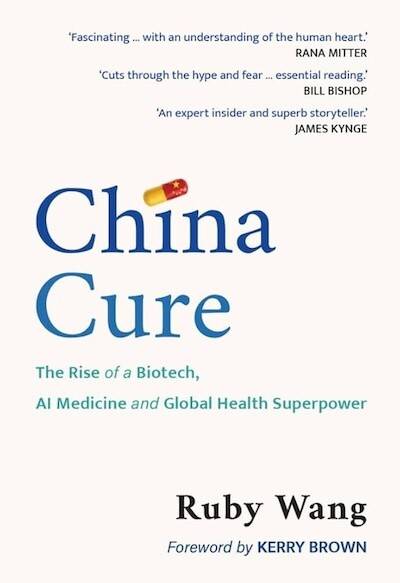
Dr Ruby Wang is a practicing physician and Director at LINTRIS Health Strategy, and the founder of ChinaHealthPulse, a newsletter and podcast on China’s health and biotech landscape. S
he previously served as Head of Health at the British Embassy in Beijing and as a Health Advisor to the United Nations in China.
Her new book, China Cure: The Rise of a Biotech, AI Medicine and Global Health Superpower, is due to be published in October 2026.

Add ICT&health on Google
Show more content from ICT&health in Google Search.


