

Researchers at the California Institute of Technology (Caltech) have developed an upgraded version of a smart mask that can continuously monitor biomarkers in exhaled breath for several days. The wearable device, powered by an integrated solar cell, could support non-invasive health monitoring and provide insights into both respiratory and metabolic conditions.
Exhaled breath contains a wide range of biological signals that reflect both lung health and broader physiological processes. However, collecting and analyzing these signals over extended periods has been technically challenging.
Wei Gao, professor of medical engineering at Caltech, and his research team previously introduced a prototype smart mask in 2024 that could analyze exhaled breath to detect biomarkers linked to respiratory conditions such as asthma and post-COVID-19 complications. The new version improves durability, usability and monitoring capabilities. The findings were published in Nature Sensors.
Extended monitoring through new materials
According to lead author Wenzheng Heng, a postdoctoral research associate in medical engineering, advances in materials science and system design have significantly extended the mask’s operational lifespan.
“We achieved long-term extension of usability through advances in materials science and system-level engineering design,” says Heng. “Building on the original mask, these upgrades enable storage and handling practicality, enhance sensing stability, and achieve energy autonomy.”
The device works by cooling exhaled breath with a hydrogel that captures exhaled breath condensate (EBC). This liquid sample is then analyzed by embedded sensors that detect biomarkers such as metabolites, pathogens and inflammatory indicators. The results are transmitted wirelessly to a smartphone, tablet or computer.
Earlier versions of the mask faced limitations because the hydrogel dried out after several hours. The research team addressed this by developing a lithium chloride infused hydrogel that resists drying and can be easily rehydrated, allowing the system to function for multiple days.
Solar power replaces batteries
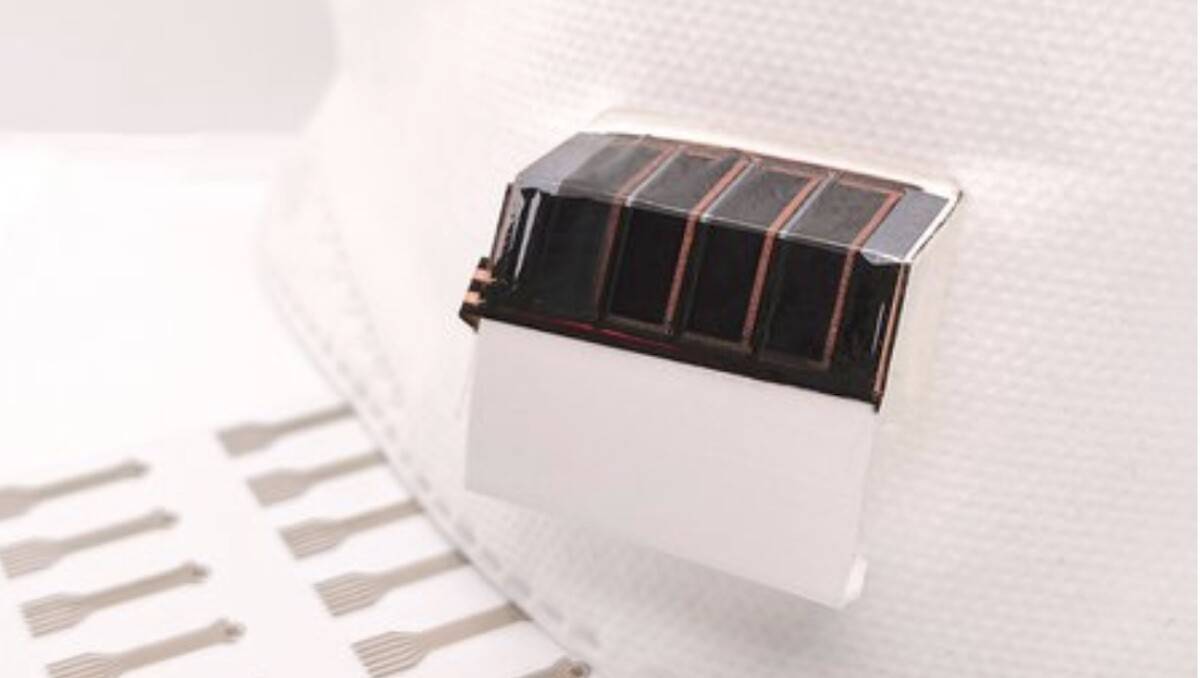
The researchers also improved sensor durability for the humid environment inside the mask by encapsulating them in a flexible multilayer material designed to withstand repeated wet–dry cycles. In addition, the updated mask eliminates the need for a battery. Instead, it uses an ultrathin integrated solar cell to power the sensors and wireless components.
“We can realize battery-free continuous operation during all different types of indoor activities,” Gao explains. “The solar cell has high-efficiency energy harvesting even in weak light; you don't have to stand under very strong California sunlight for it to work. The entire mask is now very durable and long lasting.” The material cost of the system, called EBClite, is approximately one US dollar per mask, according to the researchers.
Monitoring metabolism and physical activity
Beyond respiratory disease detection, the research team explored additional applications for the device. In a pilot study with healthy volunteers, the mask monitored lactate levels in exhaled breath during physical activity.
Lactate is an important indicator of metabolic stress and tissue oxygenation and is commonly measured in blood during exercise testing. “We showed that when the participants do different physical activities, we see the lactate increase in the exhaled breath, very similar to what we see in blood tests,” Gao says.
The researchers also tracked lactate levels after participants consumed carbohydrates, demonstrating the potential of the system to monitor metabolic changes related to diet and energy metabolism.
Heng notes that the technology could enable continuous monitoring of metabolic dynamics without invasive testing. “What excites me most is that this platform enables noninvasive and repeatable monitoring of EBC lactate that provides insight into blood lactate dynamics, supporting longitudinal tracking of lactate variability and clearance under exercise- and diet-induced metabolic changes, with potential utility in clinical settings.”
Potential for broader healthcare use
Compared with other biological samples such as sweat or saliva, exhaled breath condensate can be collected passively, making the technology potentially suitable for a wide range of users, including children, older adults and critically ill patients.
The research team has also begun exploring global health applications. In collaboration with the Gates Foundation, the researchers are investigating whether simplified versions of the mask could be deployed in low-resource settings, including parts of Africa, to support screening for tuberculosis. “We are now developing a simplified version of the mask to take to Africa that can monitor for tuberculosis, which is a very interesting and meaningful application,” Gao says.
Looking ahead, the researchers aim to expand the range of detectable biomarkers and further develop the platform for broader clinical and consumer health applications. “We really hope to make this platform more general so it can be applied to many different health conditions in our daily life,” Gao adds.

Add ICT&health on Google
Show more content from ICT&health in Google Search.


